Skip to content


While the Dragon Staff is a relatively new flow toy in the flow arts world, its roots can be traced back centuries. It originated from a Chinese weapon known as the Fei Cha, or “flying fork”. This trident-like weapon was a staple in both martial arts and hunting in Chinese culture.
Fast forward to the early 21st century, and the Fei Cha was reimagined by a collective of flow artists in the United States and Europe. By attaching two extra rods to each side of a contact staff, a new fire prop was born. The dragon staff made its debut in 2005 at the European Juggling Convention in Ptuj, Slovenia. Originally called a “10 headed staff,” its name was soon changed to “dragon staff” by its creator, Gora Krisztian. According to some reports we were able to find, this had more to do with how the staff “drags” on the body rather than any reference to a dragon’s sound or aesthetics. Other names you might see for the prop now are dragon sticks, or simply just dragons. Since then, some other prominent artists that helped revolutionize dragons were Brettdstar Schmerl, Jed Fowler, Adam Lobo, and Threeworlds

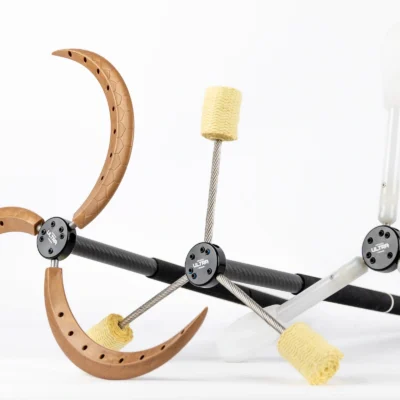
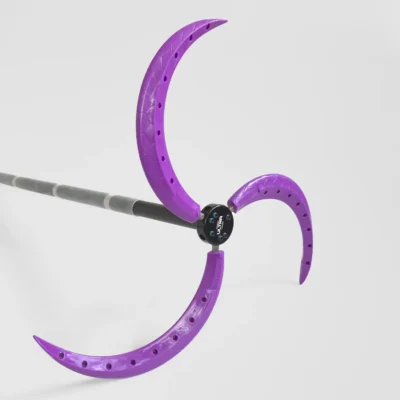
Quickly gaining popularity, the Dragon Staff became one of the most popular fire props in the flow community. Some even consider it the gateway drug to the world of flow arts. Its use ranges from solo practice to duets and group performances. The basic mechanics of a dragon staff are a longer rod with shorter rods (spokes) attached to the ends of it. Similar to a contact staff, this build makes it so that the center point of the staff feels heavier. Nowadays dragons don’t just come in 10 headed models, but can have anywhere from 4 to upwards of 10!
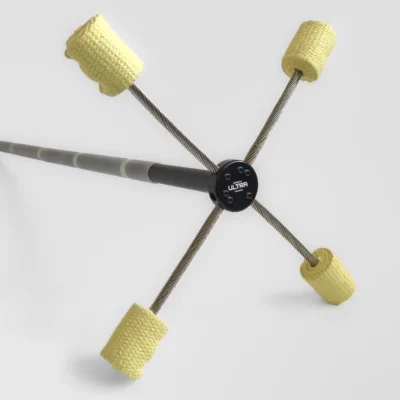
While many materials can be used for the core, aluminum (6061, 7075) and carbon fiber are most common. Similar to contact staffs, dragons require perfectly straight tubes for smooth rolling. This is why strong grades of aluminum and carbon fiber are ideal, as they are readily available in straight forms and are highly resistant (aluminum) or virtually impossible (carbon fiber) to bend. The spokes, also called spikes, are made of a diverse range of materials ranging from steel, aluminum, PU, and more, with kevlar wick or LEDs optionally attached.
The moves that can be done with a dragon staff are pretty versatile, because many contact staff moves can also be done on a dragon. Stylistically, most people prefer dragons to always be rolling, but there are many styles emerging that involve direction breaks and static spinning (no rolling at all). I really feel like the sky is the limit with how anyone uses a prop, and that having a dynamic range of movements is more interesting than sticking to any one specific style. The most common moves you’ll see with a dragon staff are chi rolls, supermans, cheating deaths, and matrixes.
A couple of variants on a traditional dragon staff are pixie dragons and partner dragons. The only real difference with these variants are the size. A pixie dragon is generally close to 4ft long (1.2m) and allows practitioners to do moves that clear under the arm. It also might make it easier for dual wielding (double dragon) but full size dragons can also be used for this purpose. A partner dragon on the other hand is closer to 6ft (1.8m) and is best suited for two people sharing one staff. The longer length makes it easier for two people to manipulate the prop at once.
Our Favorite Designs
Our favorite build of dragon staff is the Threeworlds Fusion modular dragon staff. The fusion collapsible staff, with an aluminum and carbon fiber option, itself breaks down into 3 parts and uses pressure-fit connectors, making it a convenient and safe option for storing and traveling with your dragon staff. The V3 Hubs and Ultra Hubs are modular, with the ability to switch between 3 and 4 spokes per hub as well as switching between fire, daytime, and LED. The V3 hubs can also be added to contact staffs giving you a fully modular way to switch between 2 different props! We have tested countless options and these are the most solid options we have found that are a great mix of practicality, quality, price, and versatility.
Additionally, the Flowbonacci dragon staff is an awesome daytime practice staff with many different geometrically designed head options. The new plug hubs are also pressure fit, although they fit onto the outsides of the tubing compared to Ultra hubs which are pressure fit but are inserted into the tubing.
Key Points
- Dragon staffs originate from the Chinese martial arts weapon called fei-cha
- Gora is credited with first creating and coining the term “dragonstaff” in the early 2000s in Europe. He is also a well-known performer and instructor, and he has helped to spread the popularity of dragon staffs around the world.
- Dragon staffs (or dragonstaffs) are also referred to as dragon sticks, or simply just dragons.
- Other key players in popularizing the dragon staff are Brettdstar Schmerl, Jed Fowler, Adam Lobo, and Threeworlds.
- Modern Dragon Staffs are commonly constructed from strong grades of carbon fiber or aluminum.
- Pixie Dragons, usually about 4 feet (1.2m) long, are shorter than traditional Dragon Staffs and allow for more intricate maneuvers as well as the possibility of dual wielding (double dragon staff).
- Partner Dragons, usually about 6 feet (1.8m) long, allow for coordinated performances between two people.
- The chi roll, superman, cheating death, and matrix are the most common moves people learn when starting out their dragon journey.
Hopefully this article has been useful in giving some background into the history of Dragon Staff. If you don’t have one already, check out what we have available here!